
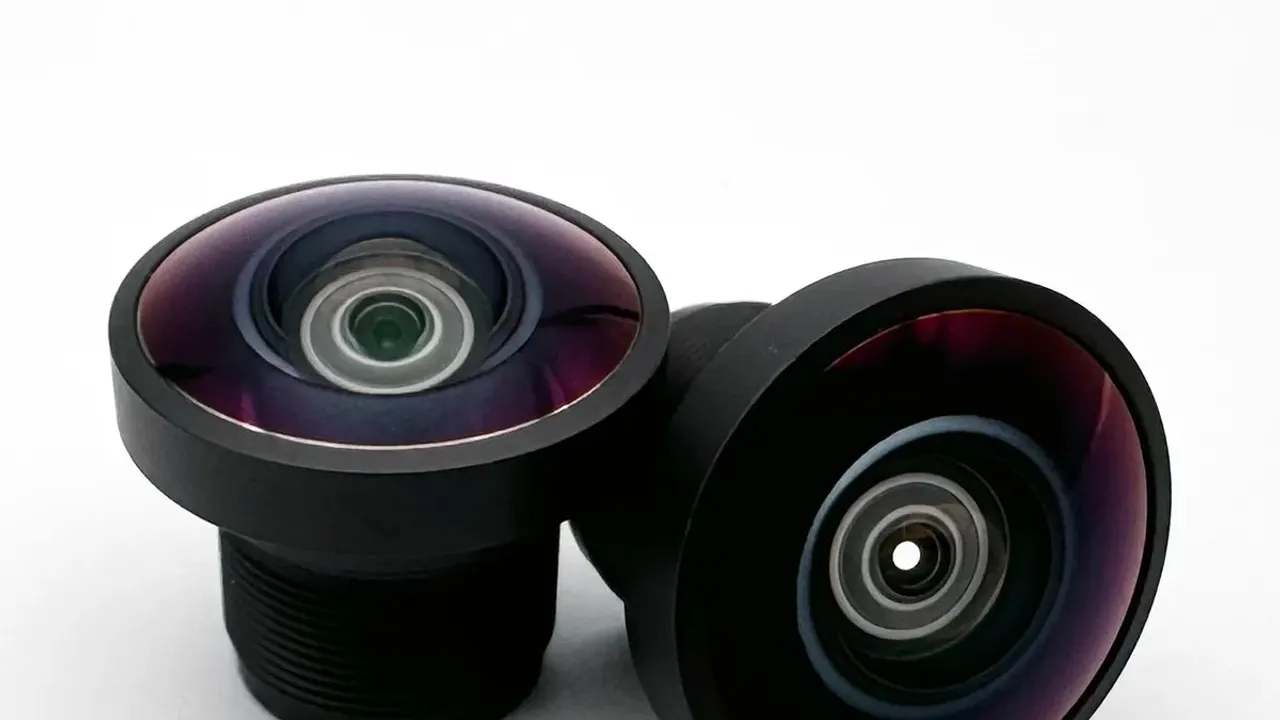
A fisheye lens packs a very wide angle onto a flat sensor by compressing the edges and stretching the centre. That is a deliberate, known distortion, and playing the file back correctly means reversing it. A player that treats a fisheye file as plain equirectangular video produces an image that is flat in the middle, stretched at the edges, and wrong in a way most people cannot name.
In short
- Named profiles: MKX200, MKX220, VRCA220 and RF52, published by HereSphere.
- Angles: fisheye scenes are often 190 or 200 degrees rather than exactly 180.
- Studios stating fisheye: SexLikeReal, POVR and RealJamVR.
- Players documenting it: HereSphere, DeoVR, Pigasus, SKYBOX, PLAY'A and Moon VR Player.
Why studios use it
Field of view. A conventional rectilinear lens covering 200 degrees is impractical, and the wider such a lens goes the more it stretches the edges of the image. A fisheye lens accepts a correctable distortion in exchange for an enormous angle on a reasonable sensor, which is exactly the trade a VR camera wants.
The result is a scene that extends past the edge of your vision rather than ending at a hard boundary, which is a large part of why modern VR scenes feel more immersive than early ones.
The profiles, and why names matter
Different lenses produce different curves, so there is no single fisheye setting. HereSphere publishes the profiles it supports by name in its file-naming FAQ: fisheye 180 with a linear lens, MKX200, MKX220, VRCA220 and RF52. Naming the lens is more precise than detecting a general fisheye mapping, and it is the reason people buy that player.
DeoVR documents fisheye at 180, 190 and 200 degrees with MKX lens correction, plus 220. Pigasus auto-detects tags including 180-degree surround spherical fisheye. SKYBOX lists VR180, 360, 200 and 220 degree content. PLAY'A and Moon VR Player name fisheye without naming profiles.
4XVR and Prism VR do not mention fisheye on any official page.
Which studios say they shoot it
Three of seventeen: SexLikeReal, POVR and RealJamVR. The last is the most explicit, describing 180-degree 3D scenes with fisheye projection alongside interactive scripts and passthrough titles.
Many more studios shoot on wide lenses without saying so, which is why the file name is the only clue for most downloads and why keeping it intact matters.
How to tell
Look at the file on a flat screen before putting the headset on. A fisheye image has visibly curved geometry and often dark or soft corners; an equirectangular image fills its half of the frame evenly with straight verticals near the centre. If the file name contains F180, MKX, VRCA or RF, it is telling you directly.
Setting it right
- Fix the stereo layout first. Stereo errors are obvious and projection errors are subtle, so settle the easy one before judging the hard one.
- Set the projection to fisheye at the angle the file name suggests, or to the named lens if your player offers it.
- Look at a straight edge in the scene, a door frame or a wall join. When the projection is right it stays straight as you turn your head.
- If nothing looks correct and the file has no tags, try 180 equirectangular and fisheye 200 in turn. Those two cover most of this market.
More formats are covered in the formats section, and the stereo side is in the side-by-side page.
Fisheye and resolution
A fisheye lens does not spread detail evenly. The centre of the frame, where the performance usually is, receives proportionally more pixels than the edges, which is part of why these scenes look good despite covering such a wide angle. The trade is that the periphery is softer than an equirectangular file of the same resolution would be there.
For most viewers that is the right distribution, because the periphery is where you are not looking. It also means that comparing two studios on resolution alone is misleading when one shoots fisheye at 200 degrees and the other equirectangular at 180.
One consequence worth planning around: if your library comes mostly from studios that shoot wide, a player that names lens profiles is worth more to you than one that supports an extra network protocol. That is the practical case for paying for HereSphere rather than adding another free app.
What is MKX200?
A camera lens profile. HereSphere names it along with MKX220, VRCA220 and RF52 as projections it can apply directly, rather than guessing.
Why does my scene look stretched at the edges?
A fisheye file is being played as plain equirectangular video. Change the projection setting.
Which player is best for fisheye?
HereSphere, because it lets you name the lens. DeoVR and Pigasus document their own detection and handle most files correctly.
Do all VR porn studios shoot fisheye?
Many do and only three state it. The file name is usually the only indication.